
8 min read
The NYC Conference Content Playbook (2026)
How to plan photo and video coverage for a multi-session conference in New York - crew, session recordings, deliverables, turnaround, and realistic budgets.
Category:
Events
Updated:
Sep 29, 2026
Matthew Hicks
Founder
The short answer: a conference is not a corporate event with more hours. It is a program of concurrent sessions, and the planning question is not "how long will you be there" but "what are you willing to miss." Budget $5,000-$8,000 for a well-covered single day, $9,000-$13,000 if you want dedicated session recordings, and $10,000-$18,000 for multi-day or multi-track programs.
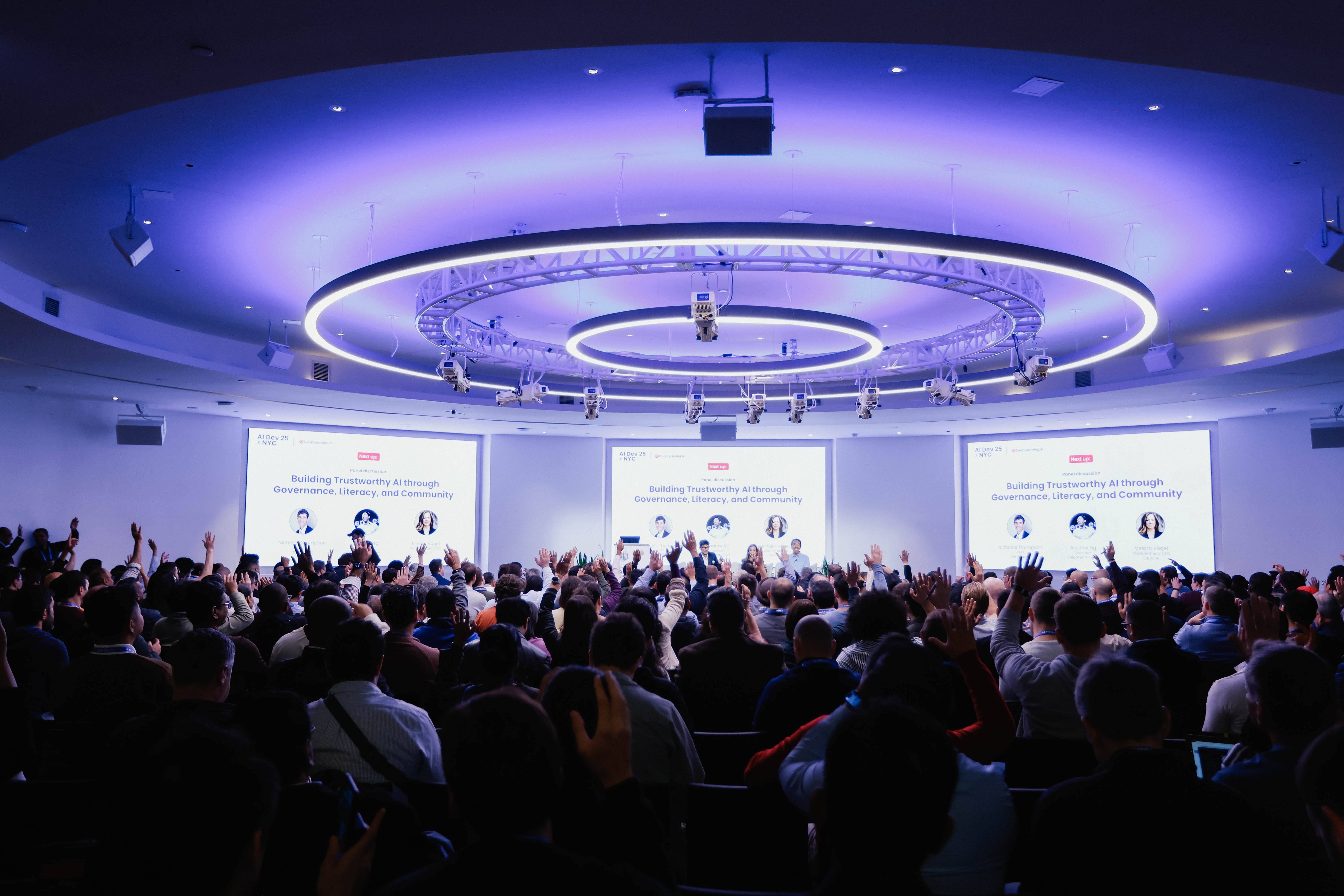
I shot two very different NYC conferences in September 2026: the Investors for a Better America conference, produced by Mediators Foundation at Fordham's Lincoln Center campus, and Regen House, produced by HowGood PBC during NYC Climate Week. One was a single room from 8am to 6:30pm. The other ran three days across multiple floors with sessions happening simultaneously. Between them they cover almost every planning decision a conference organizer has to make.
Why conference coverage is a different product
Most corporate event coverage is built around a single focal point: a stage, a launch moment, a room of people networking. One photographer can hold that. A conference breaks that assumption in three ways.
Sessions compete. When three rooms are running at once, someone is deciding in real time which two get no photographs.
Content has a second life. Panels and keynotes are not just moments to document - they are recordings you will cut up and publish for months.
Sponsors have their own expectations. If sponsors hosted sessions, they will each want proof their activation was covered, and those deliverables usually sit outside the base contract.
Decide what "coverage" means before you sign
The single most useful thing on the Regen House project was a client-built shot list paired with contract language giving the photographer judgment and discretion over timing. That combination sounds small. It is the difference between a debrief where everyone is satisfied and one where someone asks why there are no photos of the 2pm breakout.
Write down, before the event: the sessions that must be photographed, the people who must appear in frame, and the moments that exist for marketing rather than record-keeping. Everything not on that list is best-effort. See how to brief a photographer with a shot list for the format.
The deliverable stack
A conference should produce four distinct things, and they are priced separately because they are separate work.
A same-day or next-day highlight gallery. For IBA that was 40 edited images inside 24 hours. For Regen House it was 20-30 images per day, each morning, so the client could post while the conference was still running.
The full archive. IBA delivered 360+ edited images; Regen House delivered roughly 640 across three days. This is the library your team pulls from all year.
A sizzle reel. 60-90 seconds, cut from across the whole program. Both projects included two revision rounds, which is the right number.
Session recordings. The one most organizers underestimate. Covered in depth in the guide to conference panel video.
Turnaround is a planning decision, not a technical one
A gallery delivered while attendees are still in the building outperforms a better-edited gallery delivered in three weeks. That speed is bought, not wished for: it means culling on site during dead windows and having an editor working in parallel rather than waiting for the shoot to finish.
If you need next-morning images on a multi-day program, say so during quoting. It changes the crew structure.
Realistic budgets by conference shape
Single-day, single-track: full photo coverage, a recap video, and social reels - $5,000-$8,000.
Single-day with dedicated session recordings: add six to eight separately recorded and graded sessions - $9,000-$13,000.
Multi-day or multi-track: two to three days, added crew for overlaps, daily galleries - $10,000-$18,000.
Individual components price consistently with my standard rates: event photography from $800 to $4,500, recap video from $1,300, and social reel sets from $700.
Planning timeline
6-8 weeks out: share the draft agenda. Not the date - the agenda. Crew needs are set by the session grid, not the day count.
3-4 weeks out: book. Peak NYC conference season runs September-October and April-May, and good crews commit early.
1 week out: lock the shot list, confirm the venue AV contact, and confirm the address in writing.
Day before: final run-of-show. Late additions are normal - they just need to be priced rather than absorbed silently.
The rest of this playbook
FAQ
How many photographers does a conference need?
One per concurrent track during peak hours, as a starting point. A single-room program needs one. A three-floor program with overlapping sessions needs two or three for the overlap windows only - not for the whole day.
Can the same person shoot photo and video?
For general coverage, yes - photo-first with opportunistic b-roll works well. For a session that must be recorded end to end, no. That needs dedicated attention for its full length.
What if our agenda is not final?
That is normal and not a blocker. Quote off the draft, and treat added sessions as priced add-ons rather than assuming they fit.
Do you cover conferences outside New York?
Yes. Travel is quoted separately.
Planning a conference in New York? See combined photo and video coverage, or book a free 20-minute call with your draft agenda and I will come back with exact deliverables and a fixed quote.

